Each year, Switzerland produces approximately 670 kg of municipal waste per capita, placing it among the largest generators of urban waste in Europe. While the national recycling rate reaches nearly 501 TEUs, this performance masks a more critical reality: the major environmental impact of our consumption does not occur at the bottom of the bin, but rather during the extraction, manufacturing, and transportation of new goods.
According to the Federal Office for the Environment (FOEN), Switzerland's overall carbon footprint stands at 14 tonnes of CO2 equivalent per capita per year. While direct territorial emissions are decreasing thanks to advances in insulation and electric mobility, the overall footprint has stagnated. Between 651 and 701 tonnes of this footprint come from imported embodied energy, hidden within imported manufactured goods. Faced with this reality, traditional recycling is showing its limitations: the urgent need lies in extending the lifespan of objects and structuring a professional reuse sector in French-speaking Switzerland.
Beyond recycling: putting the 3Rs hierarchy back at the heart of the strategy
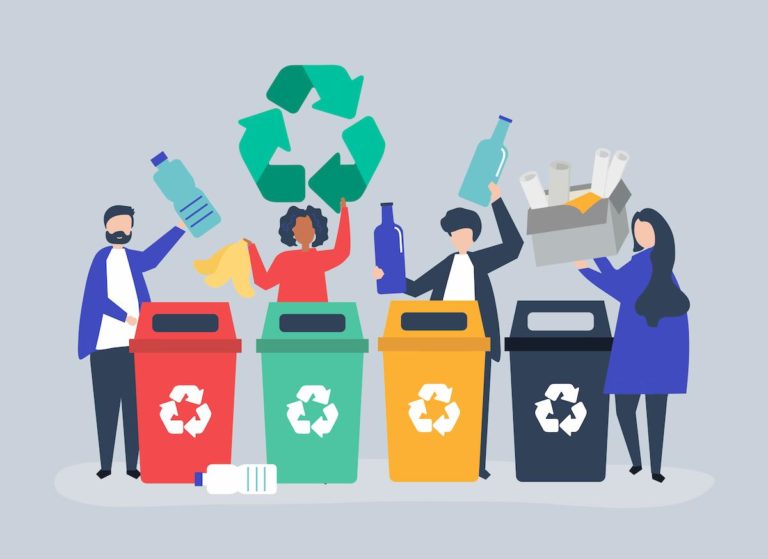
In resource management, the confusion between recycling and reuse remains persistent. Yet, these approaches occupy distinct positions in the "3Rs" hierarchy: Reduce first, Reuse second, and Recycle as a last resort.
Recycling is merely the last virtuous step before incineration. While it recovers secondary raw materials (glass, aluminum, cardboard), it requires heavy and energy-intensive thermal or chemical industrial processes. The human energy, craftsmanship, and technical value invested in the object are destroyed to extract only the raw material. Conversely, reuse preserves the object in its integrity and immediate usefulness. Reintroducing a sideboard, a lamp, or a table into a new home requires no industrial remanufacturing.
This fundamental technical distinction was highlighted by Esteem Okoro, co-founder of the Recyclage Express and Recyclage Market network, in an interview given to the Smart Media thematic supplement published in focus.swiss :
«"For me, the action with the most immediate and massive impact is reuse. Unlike recycling, an often opaque sector that remains an energy-intensive logistical and industrial process, reusing an object preserves its intrinsic value without generating new production emissions."»
Esteem Okoro, co-founder of Recyclage Express & Recyclage Market, expert in circularity and reuse
Official publication: Interview with focus.swiss (Smart Media)
See Esteem Okoro's original publication dedicated to the untapped virtues of reuse in Switzerland.
Environmental assessments confirm that reusing an existing product avoids 901 to 981 tons of greenhouse gas emissions compared to manufacturing an equivalent new product. This approach represents the most direct response to Switzerland's imported carbon footprint.
Swiss legal framework: revision of the LPE on January 1, 2025
The Swiss regulatory framework takes a decisive step forward with the entry into force, on January 1, 2025, of the revised provisions of the Federal Act on Environmental Protection (EPA) dedicated to the circular economy. This legislation commits Switzerland to the rational use of raw materials.
- Priority given to reuse and repair: The legislation formally encourages the extension of use and the recirculation of goods before any disposal.
- Accountability in public and private procurement: progressive integration of circularity criteria in public procurement, real estate management and large companies.
- Relieving congestion in municipal waste streams: Capturing waste streams upstream relieves pressure on public landfills and reduces incineration costs borne by taxpayers.
However, as Esteem Okoro points out, destroying or throwing away is often cheaper than repairing, sorting, or reselling. Without a professional logistics infrastructure capable of scaling up collection and redistribution, circularity remains a pipe dream.
Professionalizing the second-hand market: Recyclage Express's logistical solution
In French-speaking Switzerland, the opportunity was long shared between two models with obvious practical limitations:
On the one hand, sales platforms between individuals (Anibis, Ricardo, Marketplace) impose heavy time constraints (advertisements, photos, negotiations, management of visits), incompatible with the strict deadlines of a move or an inheritance.
On the other hand, the historical charitable associations (Emmaüs, CSP Vaud/Galetas, Salvation Army, Le Point Bleu), although essential to the social fabric, depend on volunteer work and limited infrastructure, forcing them to refuse many lots due to lack of space or means of transport.
To resolve this point of friction, Recyclage Express has developed a complete operational chain, combining heavy transport and environmental management.
Upstream collection, clearance and integrated services
As a’house clearance company A leading company in the Lake Geneva region, Recyclage Express captures waste directly at the source: private homes, estates, offices, shops and archives.
On-site, teams systematically sort recyclable materials (wood, scrap metal, paper, cardboard) from reusable, functional goods. The service offering meets all the needs of individuals and professionals:
- Complete clearing of apartments, villas, cellars, attics and commercial premises,
- Logistics for the transport and handling of heavy or delicate equipment,
- Secure destruction of archives and confidential documents for businesses and public authorities.,
- Regular collection subscriptions for property management companies, businesses and institutions,
- Full service of end of lease cleaning in Lausanne and in the canton of Vaud, with a guaranteed inventory of fixtures for the handover of keys.
This integration allows for the complete handling of a property, from clearing out to the inventory, with a single point of contact guaranteeing rigorous traceability.
The lever of deductible capital gains: reconciling economy and ecology
The Express Recycling model is based on a virtuous financial mechanism: tax-deductible valuation. During the estimation of the price of a house clearance, Experts assess the market value of furniture, works of art, lighting fixtures and equipment in good condition.
This estimated value is directly deducted from the clearance quote. The client benefits from a tangible discount on their bill while avoiding sending perfectly functional items to the landfill. This approach transforms a costly chore into a beneficial circular economy. To assess the cost of a service, you can obtain a free online junk removal quote in just a few clicks.
Recycling Market in Morges: Omnichannel at the service of second-hand goods
Capturing the flow of unwanted items during clearance sales is not enough: it is necessary to offer these objects a credible, modern, and desirable commercial outlet. Launched at the end of 2021, the brand Recycling Market transforms the opportunity experience in French-speaking Switzerland.
Located in Morges (12 Avenue de Riond-Bosson), the physical store offers a spacious, bright showroom where every piece of furniture and object is cleaned, checked, and displayed to its best advantage. This meticulous approach breaks with the cluttered aesthetic of traditional flea markets.
Recyclage Market's unique feature lies in its complete digital synchronization: the physical store is connected in real time to an e-commerce platform. Managing a unique inventory of used items (where each piece is one-of-a-kind) presents a significant technical challenge. Thanks to this infrastructure, a buyer can order a piece of furniture they've found online with the immediate guarantee of reserving it in-store.
By offering quality products at affordable prices, this operational complementarity supports household purchasing power while maintaining economic value within the Swiss territory.
Towards a functional economy and local responsibility
To accelerate this transition, several levers deserve to be implemented more broadly in Switzerland:
- An incentive-based circular VAT: Reducing VAT on second-hand goods, which are already taxed when they are first sold, would stimulate the purchase of second-hand goods.
- Clear indicators of repairability: inform consumers about the technical durability of new equipment to discourage disposable products.
- Public-private collaboration: to forge active partnerships between municipalities, property management companies and logistics actors of circularity to intercept objects before they are shredded at the waste disposal center.
By uniting over 5,000 satisfied individuals and businesses in French-speaking Switzerland (including major clients such as EPFL, the World Economic Forum (WEF), Victorinox, Manor, Bernard Nicod, and Apleona) and maintaining a 4.9 out of 5 rating based on over 450 verified Google reviews, the operational alliance between Recyclage Express and Recyclage Market demonstrates that circularity is a viable economic model, creating local, non-relocatable jobs and essential for reconciling resource conservation and economic prosperity. For any questions or urgent requests, the teams can be reached at [phone number/email address]. +41 21 703 06 08 or by WhatsApp 24/7.
Need an eco-friendly clearance service with tax-deductible value?
Benefit from a direct financial deduction on your quote by reusing your furniture and belongings.

Free, no-obligation quote